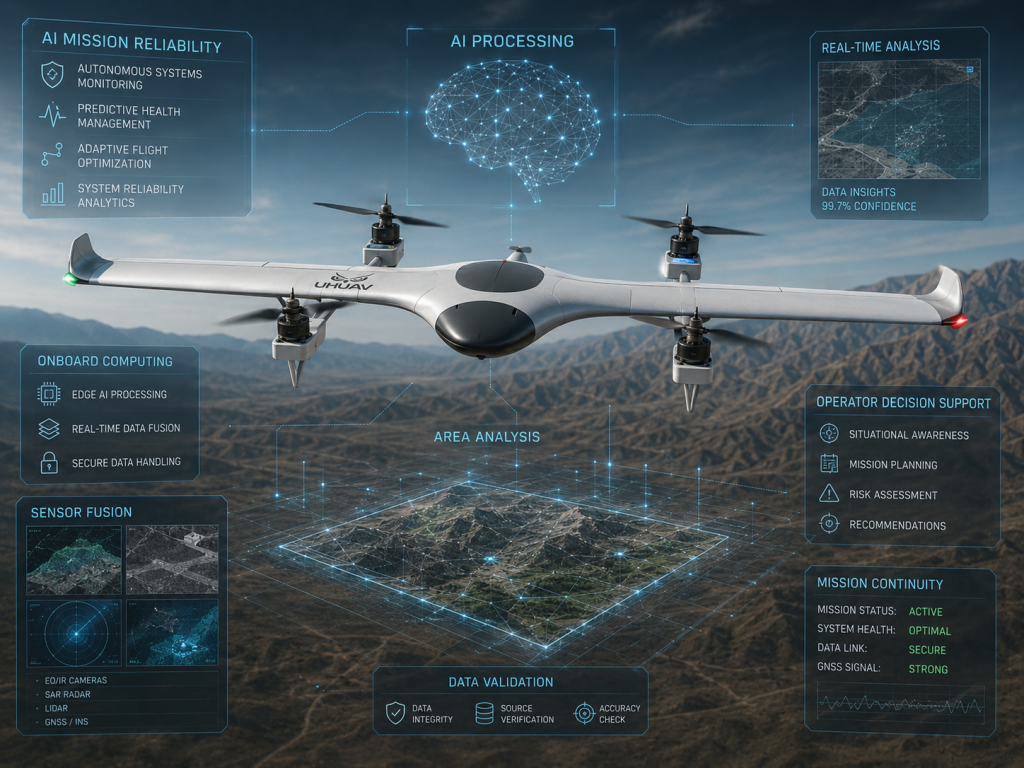
From DJI Drone Service Experience to Surveillance UAV Engineering
How long-term diagnostic and field-service experience shaped a mission-first approach to VTOL platforms, payload integration, AI-assisted monitoring and maintainable UAV systems.
Drone service and UAV development are different disciplines, but both demand the same fundamental mindset: an unmanned aircraft must be understood as a complete system rather than a collection of isolated components.
Since 2016, our team has provided DJI drone service, building hands-on experience in diagnostics, repair, maintenance, calibration and post-service verification. That history now informs a separate engineering direction focused on mission-specific surveillance, security and infrastructure-monitoring UAV systems.
A Drone Service History That Began in 2016
A professional service environment provides continuous feedback about how aircraft behave outside ideal laboratory conditions. A problem that first appears to involve one component may also be influenced by power delivery, sensors, mechanical damage, configuration, communications or operating conditions.
Service experience alone does not automatically qualify a team to develop every category of UAV. Its value lies in the engineering habits built through repeated diagnosis, corrective work and verification:
- Examine evidence before reaching a conclusion.
- Isolate the root cause instead of replacing parts by assumption.
- Consider interactions among mechanical, electrical and software systems.
- Verify aircraft behaviour after corrective work.
- Design with inspection, maintenance and field support in mind.
- State performance only when it is supported by the final configuration and test conditions.
These principles form the engineering continuity between our DJI drone service work and UHUAV’s mission-specific development approach.
The Same Owners and Lead Engineers, a Different Engineering Mission
The relationship between DJI Servisi and UHUAV is based on shared ownership, engineering leadership and accumulated technical experience. The same people responsible for directing the service operation also direct UHUAV’s technical development.
This continuity does not mean UHUAV aircraft are modified DJI products. UHUAV evaluates mission-specific systems around the required airframe, payload, power architecture, data link, ground segment, operating environment and regulatory constraints.
| Service discipline | Relevance to mission-specific UAV engineering |
|---|---|
| Root-cause diagnosis | Separates symptoms from mechanical, electrical, configuration or software causes. |
| Power-system inspection | Informs power budgeting, connector selection, distribution and payload integration reviews. |
| Sensor and calibration work | Reinforces the need for installation checks, configuration control and post-integration verification. |
| Gimbal and camera servicing | Highlights vibration, balance, data, control and field-access requirements for mission payloads. |
| Post-service testing | Supports configuration-specific acceptance criteria instead of relying on generic headline figures. |
Engineering UAV Surveillance Systems as Complete Systems
A surveillance UAV is not defined by its airframe or camera alone. Reliable UAV surveillance depends on how the aircraft, payload, communication link, onboard processing, ground-control system and operator workflow function together.
Selecting a UAV for surveillance should begin with the operating problem:
Coverage and movement
Define the area, route or corridor, required observation points and whether hovering or efficient forward flight matters most.
Mission payload
Identify the required daylight, thermal or customer-selected sensor and the information it must deliver.
Data and control
Review video, telemetry, command, recording, reporting and communication-line-of-sight requirements.
Deployment and support
Plan launch, recovery, transport, maintenance, training, permissions and operating responsibilities.
This system-level definition is more dependable than choosing an aircraft from a headline specification and forcing the mission to fit it.
When a VTOL UAV Is the Appropriate Platform
A VTOL UAV combines vertical takeoff and landing with efficient forward flight. This architecture can be useful where a runway is unavailable but the mission calls for route or area coverage beyond the practical scope of continuous multirotor flight.
For organizations evaluating a commercial-grade VTOL security UAV, “commercial-grade” should be translated into documented engineering requirements rather than treated as a general marketing label. Relevant evidence can include verified payload compatibility, configuration-specific test results, stated operating limits, maintenance arrangements, operator training and agreed acceptance procedures.
A VTOL unmanned aerial system is not automatically the best answer for every surveillance mission. A multirotor may be more suitable for close inspection and stationary observation, while another fixed-wing configuration may better serve missions with prepared launch and recovery areas. Platform selection should follow the operating need.
What AI Drone Surveillance Can—and Cannot—Do
An AI drone surveillance system can support the operator by processing imagery and mission data, identifying relevant events and reducing the workload created by continuous video observation. Depending on the selected sensors, computing hardware, software and mission design, AI-assisted functions may include object detection, operator-selected target tracking, event tagging, route monitoring, anomaly highlighting and mission-data organization.
AI assistance should not be presented as guaranteed autonomous judgment. Detection and tracking performance can vary with camera quality, distance, altitude, lighting, weather, target visibility, training data and computing resources.
Human oversight remains essential. The operator should be able to verify detections, supervise the mission, change or stop approved actions and review recorded mission information. Any accuracy figure should be tied to a defined test method and a named system configuration.
UAV Payload Protection Starts at the Interface
The mission payload is part of the aircraft system, not an accessory added after airframe selection. UAV payload protection begins with correct mechanical, electrical, thermal and data integration.
Mechanical fit
Payload mass, centre of gravity, mounting strength, vibration exposure and service access.
Electrical fit
Voltage, peak demand, power distribution, protection, connector choice and cable routing.
Thermal and environmental fit
Heat dissipation, airflow and exposure to the conditions defined for the intended operation.
Data and control fit
Video, telemetry, payload commands, time synchronization, storage and operator-interface compatibility.
Protection should not be described with an ingress or environmental rating unless that rating has been tested and documented for the final product. The same rule applies to endurance, range, wind limits and other values affected by payload selection.
Aerial Surveillance and Monitoring for Oil-Pipeline Corridors
Oil pipelines, associated roads, rights of way and remote facilities create a linear monitoring problem. An aerial surveillance and monitoring UAV for oil-pipeline operations may need to cover distributed assets across difficult terrain while collecting repeatable visual or thermal information for authorized operators.
A credible system review should consider corridor length and terrain, required inspection detail, daylight or thermal payload needs, launch and recovery points, communication line of sight, recording and reporting outputs, weather, seasonal conditions, deployment logistics and applicable aviation and privacy rules.
A VTOL platform may be appropriate where runway-independent deployment and efficient forward flight are both required. The final choice, however, should follow a technical review rather than a generic platform claim.
Why Verifiable Claims Matter
Surveillance and security projects are often compared using isolated headline figures. Those figures can be misleading when the tested payload, aircraft weight, weather, route, communication equipment and operating conditions are not stated.
Our preferred approach is to define the mission first and then document the configuration to be evaluated. Performance values should come from engineering review and an agreed verification process, not from assumptions carried across different aircraft or payloads.
This principle reflects the most important continuity between service and development: inspect the evidence, understand the complete system and verify the result.
How a Mission-Specific Review Begins
1. Define the mission
Describe the site, corridor, observation goal, operating environment and required outputs.
2. Define the payload
State the sensor type, mass, power, control, data and stabilization requirements where known.
3. Select the platform
Compare VTOL, multirotor or another architecture against launch, recovery and coverage needs.
4. Review the complete system
Evaluate airframe, payload, power, communications, ground control, maintenance and training together.
5. Agree on verification
Define which values, functions and operating limits must be demonstrated for the selected configuration.
6. Prepare the proposal
Document the configuration, assumptions, test scope, training, support and delivery requirements.
Questions About DJI Servisi, UHUAV and Surveillance Engineering
What is the relationship between DJI Servisi and UHUAV?
DJI Servisi and UHUAV share the same owners and lead engineers. The connection is the people, engineering experience and service-informed working method. UHUAV is independently developed and is not presented as a DJI product, subsidiary or program.
Does UHUAV modify DJI drones into surveillance UAVs?
That is not the relationship described here. UHUAV’s mission-specific engineering work is separate from DJI drone service activities. The transferable value is the team’s experience in diagnostics, system integration, verification and maintainability.
What defines a commercial-grade VTOL security UAV?
“Commercial-grade” is not a universal aircraft class. It should be supported by configuration-specific evidence such as payload compatibility, tested performance, documented operating limits, maintenance planning, training and agreed acceptance procedures.
Can a VTOL UAV support oil-pipeline monitoring?
Pipeline-corridor monitoring is a relevant VTOL application when runway-independent deployment and efficient route coverage are required. Suitability depends on terrain, payload, required inspection output, communication conditions, operating rules and the verified aircraft configuration.
What does AI add to a surveillance UAV?
AI-assisted processing can support detection, tracking, event tagging, route monitoring and operator decision support. It does not guarantee correct interpretation, and the operator remains responsible for reviewing mission information and making operational decisions.
How is a surveillance payload protected?
Payload protection can include suitable mounting, vibration management, electrical protection, thermal design, cable and connector protection and environmental measures. Any specific protection rating should be stated only after it has been tested and documented.
DJI is a trademark of its respective owner. Its use on this page identifies the brand of aircraft serviced and does not imply that UHUAV is affiliated with, sponsored by or endorsed by DJI.